
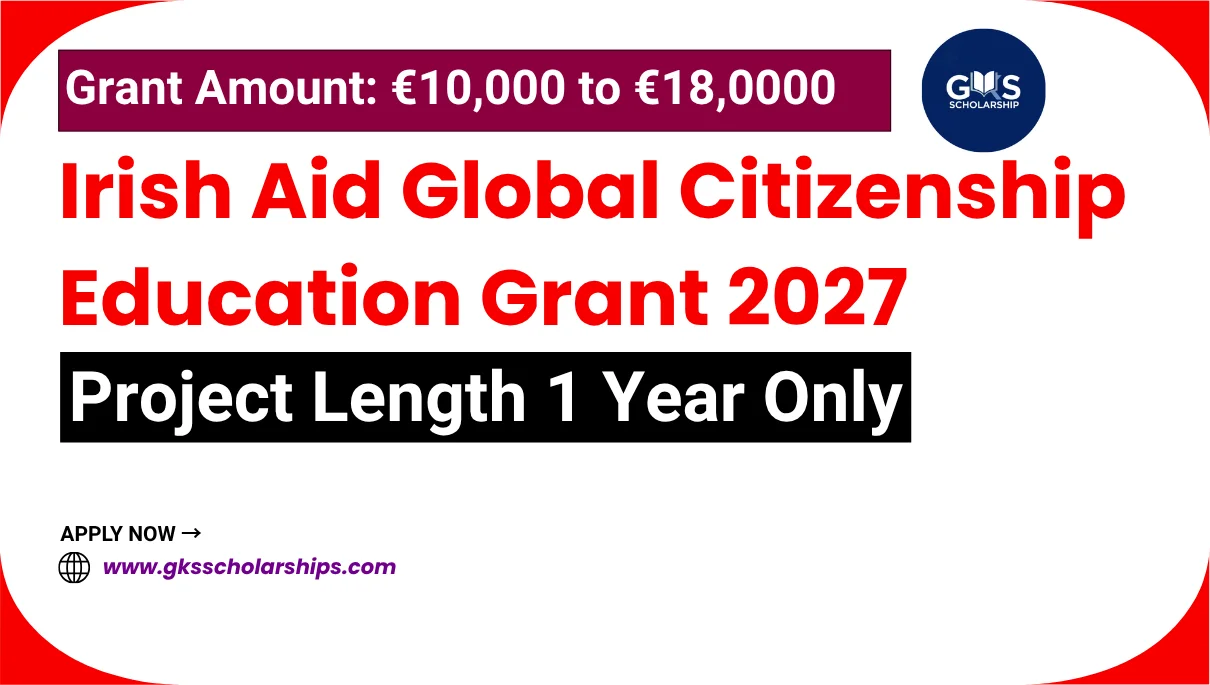
Irish Aid is funding Irish based organisations that teach people in Ireland about global development. The 2027 Global Citizenship Education Grant gives between €10,000 and €18,0000 for one year projects. The Department of Foreign Affairs runs it through Irish Aid. The full application deadline is 12 noon on 9 December 2026.
One step has already closed. Every organisation had to send an eligibility form by 12 noon on 6 November 2026. Organisations that missed it cannot apply in this round. If your organisation sent the form Irish Aid will tell you by 9 November 2026 if you can go on to the full application.
At a Glance
Official information checked: 7 November 2026
| Item | Details |
| Grant | Irish Aid Global Citizenship Education (GCE) Grant 2027 |
| Funder | Irish Aid at the Department of Foreign Affairs |
| Who can apply | Irish based organisations only |
| Grant size | 10000 to 180000 euros |
| Project length | One year only |
| Eligibility form deadline | 12 noon on 6 November 2026 (closed) |
| Eligibility notice | By 9 November 2026 |
| Full application deadline | 12 noon on 9 December 2026 |
| Funding decisions | March or April 2027 |
Grant Benefits
- A grant of 10000 to 180000 euros for a one year project
- 100 percent of the grant paid when you return a signed contract
- A special budget for the Innovation Challenge Fund inside the grant scheme
- Dear co-funding of up to 10 percent of the EU funds your organisation receives
- Dear co-funding for projects of one two or three years
- A chance to hold both a GCE grant and DEAR co-funding if you win both
| Funding route | Amount | Length | Deadline |
| GCE Grants Scheme 2027 | 10000 to 180000 euros | One year only | 12 noon on 9 December 2026 |
| Dear co-funding | Up to 10 percent of total EU funds for the year | One to three years | Any time of the year |
Each organisation can hold only one grant under each route for the length of that grant.
Innovation Challenge Fund
The scheme has a special budget to support new ideas. In its guidelines Irish Aid names these types of innovation:
- Reaching new audiences including people left out of formal education
- Using new technologies to engage learners of all ages in Ireland including links with the Global South
- New ways to build global citizenship education into a whole school or a whole institution
- New ways to monitor and evaluate your work
- Other ideas that you clearly explain as innovative
DEAR Co Funding
DEAR means Development, Education and Awareness Raising. An Irish based organisation that receives EU money for a DEAR project can ask Irish Aid for co-funding.
- Irish Aid can give up to 10 percent of the total EU funds you receive in a year
- Projects can last up to three years
- You can apply at any time and no deadline applies
- The process has three phases. These are an expression of interest a concept note and a funding application
- Contact the Global Citizenship Education Unit when you first apply for EU funding. Do this before the expression of interest
- Tell them about the project and the co-funding you want
- Irish Aid may agree once the EU approves your DEAR application
- You can apply for DEAR co-funding as well as a GCE grant
Also Read: HBS Africa Business Club New Venture Competition 2027: Pitch for a $55,000 Prize Pool
Who Can Apply
Only Irish based organisations can apply. Your organisation must meet all eight rules.
- Status. You have been a registered charity with the Irish Charities Regulatory Authority or the Charities Commission of Northern Ireland for at least two years. Or you hold an up to date Tax Clearance Certificate. Social enterprises, educational institutions, trade unions and cooperatives can also apply. You should follow the Charities Governance Code and meet the annual reporting rules
- Governance. You have a formal decision-making structure that can take legal responsibility for Irish Aid funds
- Accounts. Your annual accounts for the two most recent financial years are on your website on 6 November 2026. If your yearly income is above 100000 euros they must be externally and independently audited
- Dependency. Income from Irish Aid, direct or indirect must be no more than 90 percent of your total income
- Funding status. Organisations that get the Irish Civil Society Programme or are Strategic Partners of the Global Citizenship Education Unit are not generally eligible. Dear co-funding is the exception
- Focus. Your education work includes a global citizenship perspective aimed at the public in Ireland
- Compliance. If you got Irish Aid funds before you have sent your reports on time and signed a Certificate of Assurance. A record of non-compliance rules you out
- Child protection. If you work with people under 18 you have child protection policies that follow the Children First Act 2015
Projects and Costs That Are Not Eligible
Projects
- Projects aimed at post primary schools. The WorldWise Global Schools programme covers these
- Proposals limited to individual schools
- Projects whose main aim is to raise your profile or raise funds
- Projects with a development studies focus and not a global citizenship education focus
- Welfare projects such as language classes or legal and social welfare information
- Research. Monitoring and evaluation are allowed
- Exposure visits overseas
Costs
- Costs outside the project dates and costs before the project start date or contract
- Capital or equipment costs, unless they are essential to the project
- Consultant fees to write applications
- Buying, repairing or furnishing buildings
- Paying debts or loans
- Contingencies
- Printing other than materials needed for example for workshops
- Organisational development
Content rules
- Campaigning and advocacy projects must show real global citizenship education content
- Cultural events must be part of a wider global citizenship education project
- Anti racism intercultural and environmental education projects must make local and global connections
Application Process
- Ask for the eligibility form by writing to globalcitizenshipeducation@dfa.ie. This stage closed on 6 November 2026.
- Irish Aid tells you by 9 November 2026 if you are eligible. If you hear nothing contact Irish Aid.
- If you are eligible Irish Aid sends you the application form. The form includes guidance notes.
- Complete the application form and the appendices.
- Have your legal representative sign the form. This is for example your CEO or the chair of your board.
- Email it before 12 noon on 9 December 2026. Irish Aid accepts email applications only. Late applications are not considered.
Visit official website to apply
How Applications Are Judged
External consultants help appraise the applications. The Global Citizenship Grants Committee then makes recommendations to the Minister of State for Overseas Development and Diaspora. The committee has members from several government departments the National Council for Curriculum and Assessment and external consultants.
Irish Aid judges your proposal under these headings:
- Project proposal. This covers quality and your capacity to deliver
- Global citizenship education approach
- Strategic approach
- Evidence of change
- Governance and financial oversight
- Innovation Challenge Fund if you apply to it
Irish Aid expects to appraise applications in the first quarter of 2027 and tell you the result in March or April 2027. Decisions can be delayed. A grant offer is provisional until the Department confirms that you meet all conditions. You may need to send a revised budget flow of funds and results framework.
Project Dates and Reporting
Project dates
- Projects can start on or after 1 April 2027
- Projects must start no later than 1 September 2027
- Projects must finish by 31 August 2028
- Any delay must be agreed with Irish Aid in advance
If you win
- Irish Aid gives you a yearly contract and pays 100 percent of the grant when you sign it
- You must send an End of Project Report one month after the project end date. Late reports are a compliance issue
- Reports need a results framework a financial report a signed Certificate of Assurance your latest annual accounts showing Irish Aid funding and a link to your latest annual report to the Charities Regulator
- If your grant is above 50000 euros you must also send a short case study with photos and quotes that follow GDPR
- You must work with any evaluation or audit and answer requests for information on time
- You must show this credit on every resource you make: funded by Irish Aid at the Department of Foreign Affairs. You must also state that the ideas are those of the authors and not DFAT policy
- You must share resources on developmenteducation.ie
- Your forms and reports become Department records under the Freedom of Information Act 2014
Key Dates
- 2 November 2026: Public information session held online
- 3 November 2026: Application process launched by the Minister of State
- 6 November 2026 at 12 noon: Eligibility form deadline and accounts must be on your website
- 9 November 2026: Organisations told if they are eligible
- 9 December 2026 at 12 noon: Full application deadline
- First quarter of 2027: Applications appraised
- March or April 2027: Funding decisions
- 1 April 2027: Earliest project start date
- 1 September 2027: Latest project start date
- 31 August 2028: Projects must finish
- Any time: DEAR co funding applications