
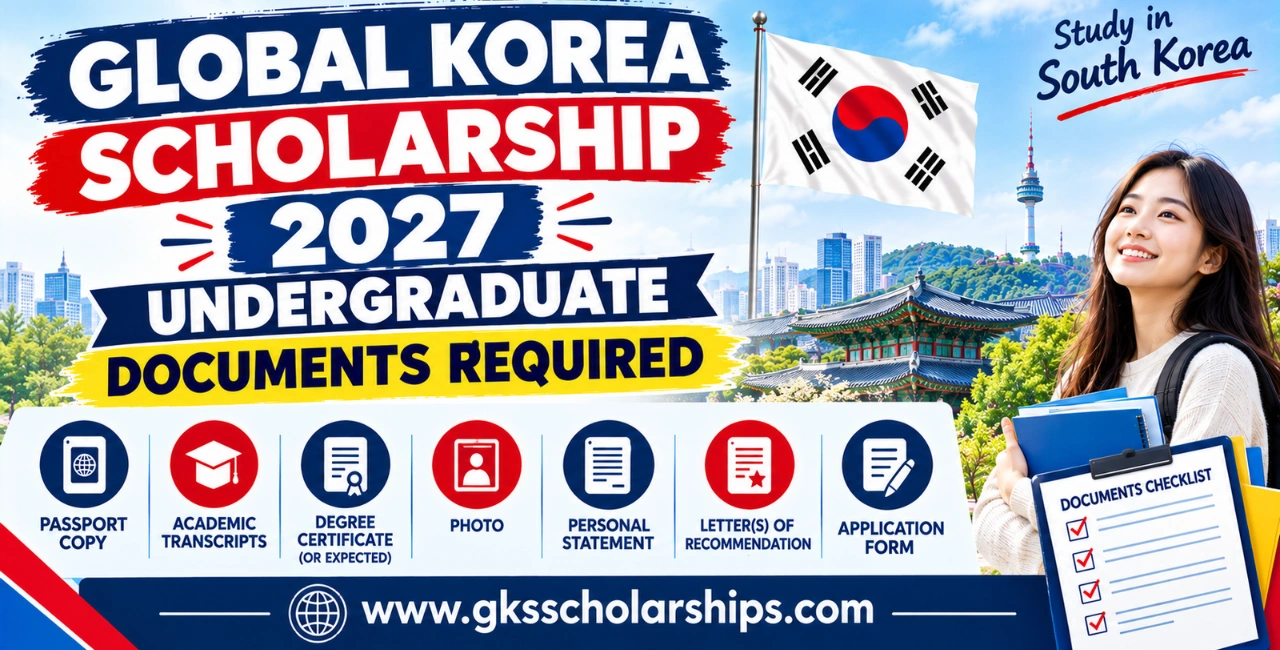
Every year, strong students lose their shot at the Global Korea Scholarship for reasons that have nothing to do with their grades or their Personal Statement. A name spelled slightly differently than the passport. A missing apostille. A transcript in the wrong grading scale.
The essay gets all the attention. The documents are what actually break applications. If you are applying for GKS 2027, this is the part of the process worth slowing down for.
Published on: September 15, 2026. Document requirements follow official NIIED guidelines for the GKS cycle. Always confirm the latest University Information file and track-specific notices before submitting.
At a Glance
| Detail | Information |
|---|---|
| Scholarship | Global Korea Scholarship GKS |
| Critical focus | Required certificates and authentication |
| Forms needing authentication | None |
| Certificates needing authentication | Citizenship graduation transcript and related |
| Authentication type | Apostille or Korean consular confirmation |
| Tracks | Embassy Track and University Track |
| Common failure point | Incomplete or improperly authenticated documents |
Three Categories, Not One Pile of Papers
The GKS application splits your documents into three distinct groups, and treating them the same way is a common mistake.
- Application forms. Seven official forms you fill out yourself.
- Required certificates. Official proof documents such as citizenship records, graduation certificate and transcript.
- Supporting documents. Optional extras like language test scores and award certificates.
Only the middle group’s certificates generally need an apostille or consular authentication. Mixing this up or assuming everything needs the same level of official stamping is where a lot of applicants waste time or worse, submit an incomplete package.
The Seven Forms You Have to Complete
These forms do not need authentication but they do need to be accurate and fully signed.
1. Application Form
Your personal details, program choice and university department selections. This must be written in English and your name has to match your passport exactly including middle names.
2. Personal Statement.
Your background, motivations and achievements. English or Korean is fine. The key is consistency. Your story should clearly connect to your intended major and your Study Plan.
3. Study Plan.
How you will build your Korean language skills, what you intend to study and how this scholarship fits your future career.
4. Recommendation Letter.
From someone who can genuinely speak to your academic ability issued within the past year. One letter is required, though you can submit up to two.
5. GKS Applicant Agreement.
Confirms you accept the scholarship’s rules. Read every line before signing. A missing signature here can disqualify an otherwise strong application.
6. Personal Medical Assessment.
A self-reported health form. Answer honestly.
7. Consent to Collect and Use Personal Information.
Authorizes the review process. Every section needs to be completed and signed.
Small detail, big consequence. Use the exact university and department names listed in the official 2027 University Information file. Writing a department name slightly differently than the official listing is a documented cause of rejection.
The Certificates That Actually Need Authentication
This is where most of the real work happens and where most delays occur.
Citizenship and family relationship proof. You need a document that clearly shows both your relationship to your parents and your citizenship status. Here is the trap. A document showing your ethnicity, birthplace or place of residence does not count as citizenship proof. If your civil documents do not clearly state citizenship you will need to attach a passport copy or another government ID that does.
High school graduation certificate. If you have already graduated, submit your diploma with a clear graduation date. If you are still finishing school, an expected graduation certificate works but only if it clearly shows the expected graduation month or date. Expected graduates must actually graduate by 31 December 2026 and if selected in the first round, must submit their final certificate and transcript by that same date.
Academic transcript. Your transcript needs to use a recognized grading scale 4.0, 4.3, 4.5, 5.0 or a 100-point system. If your school uses something else you will need an official conversion or a written explanation of your school’s grading system from the school itself. A conversion from a site like Scholaro or WES is only accepted if your school officially confirms it.
If you are applying based on an associate degree rather than straight from high school that degree’s certificate and full transcript replace the high school records as your primary academic evidence.
Documents You Only Need in Specific Situations
A few documents apply only to certain applicants but they matter a great deal if they apply to you:
- Overseas Korean or adoptee proof for applicants using that specific pathway
- Korean citizenship renunciation proof if you or a parent previously held Korean citizenship. A simple application for renunciation is not enough. You need proof the renunciation was finalized.
- Korean War veteran descendant proof for applicants claiming additional selection points through that route
If none of these apply to you, skip them. Submitting irrelevant documents does not strengthen your file.
Language Scores and Optional Extras
TOPIK, TOEFL and IELTS scores are all optional under the general GKS guidelines, though a specific university or department might require them. If you have a strong score, submitting it can genuinely help your application.
For awards and activity certificates, you are allowed up to five. But more is not automatically better here. A curated set of five documents that directly connect to your Personal Statement and Study Plan will do far more for you than five loosely related certificates thrown in to fill the slots.
Your passport copy is technically optional too but it becomes important whenever your citizenship documents do not clearly state your nationality or when you need to confirm your English name matches exactly.
The Apostille Question Explained Simply
This is the single most confusing part of the process for most applicants so here is the short version.
If your document was issued in a country that is part of the Apostille Convention, get an apostille. If it was not you will need consular confirmation from a Korean embassy or consulate instead.
If your document is not in English or Korean, attach a certified translation. You only need to authenticate one version, either the original document or the translation not both.
Here is a mistake that trips up a lot of applicants. A photocopy of an already apostilled document is not accepted. Neither is an ordinary notarized copy of an authenticated document. If you cannot submit the original, you need an acceptable certified true copy issued either by the same authority that provided the apostille or by a Korean embassy after they have verified the original.
Embassy Track vs University Track (Different Submission Rules)
How you submit your documents depends entirely on which track you are applying through.
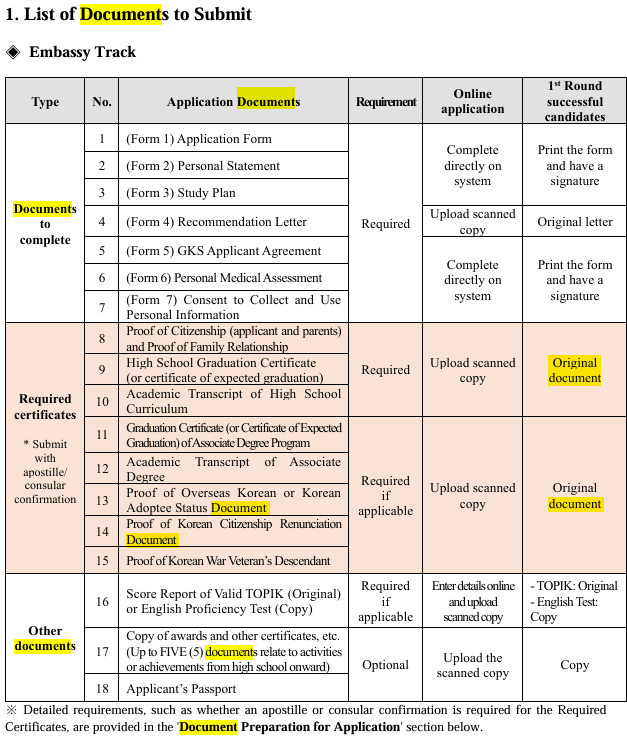
Documents Required for Embassy Track
Embassy Track applicants apply online through the Study in Korea system. In the first round, you upload scanned copies of everything. If you pass that round, you then print your forms, sign them by hand and submit an original signed set along with the required authenticated certificates by the embassy’s deadline.
Documents Required for University Track
University Track applicants skip the Study in Korea system entirely. You apply directly to one university and one department following that university’s own instructions and deadlines. The general NIIED checklist still applies but each university may add its own specific requirements on top of it.
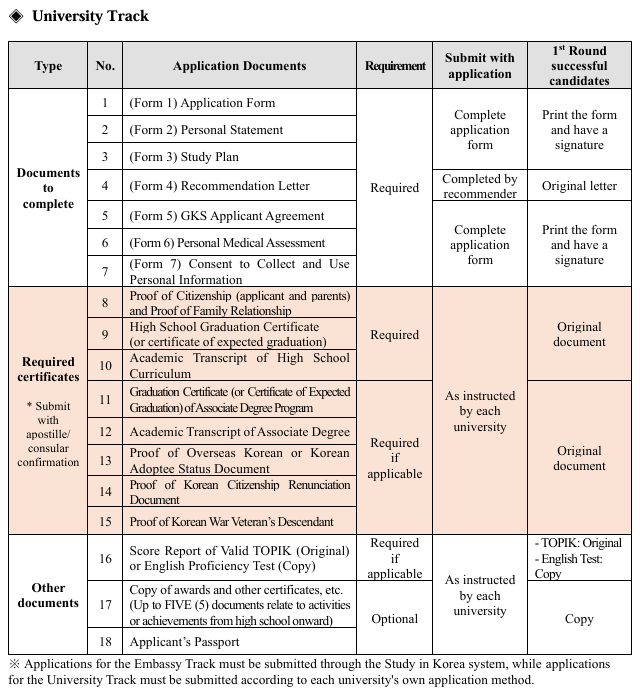
If you are going the University Track route, checking your chosen university’s own 2027 GKS notice is not optional. The general checklist alone is not enough.
How to Physically Organize Your Documents in 2027
Once everything is gathered and authenticated, presentation still matters.
- Use the official Application Checklist as your cover page
- Arrange documents in the exact order the checklist specifies
- Number and label each document in the upper-right corner
- Use A4 or Letter-size paper throughout
- Mount smaller documents onto a full-size blank sheet
- Fold anything larger than A4 down to size
- Double-check every required signature before submission
And keep a complete scanned copy of everything. NIIED does not return submitted documents so once they are sent you no longer have the originals unless you kept copies beforehand.
The Mistakes That Actually Cause Rejections
Based on the official guidelines these are the specific errors that repeatedly cause problems:
- A missing signature on one of the application forms
- A name that does not exactly match the passport
- Citizenship documents that show birthplace or ethnicity instead of actual citizenship
- An expected graduation certificate with no expected graduation date listed
- Grades submitted without an accepted scale or an official conversion
- An ordinary notarized copy is used where an apostille or consular confirmation is required
- A plain photocopy of an already-authenticated document
- A missing certified translation for a non-English non-Korean document
- A department name that does not match the official University Information file exactly
- More than five optional award documents were submitted
- Ignoring extra requirements specifically requested by an embassy or university
Almost every item on this list is avoidable with careful preparation. None of them relate to how strong the applicant actually is academically.
Why This Level of Detail Matters
The GKS Scholarship is genuinely competitive and NIIED reviews an enormous number of applications each cycle. When reviewers are working through that volume of documentation, errors are an easy objective reason to set an application aside regardless of how compelling the applicant’s Personal Statement might be.
This is also why starting early matters more than it seems. Authentication, whether through an apostille or a Korean consulate and certified translation, both take real time. Waiting until close to the deadline to request these documents is one of the most common and most avoidable reasons applicants run out of time.
If you are preparing a GKS 2027 application, treat the document checklist with the same seriousness as your Personal Statement. A brilliant essay attached to an incomplete or improperly authenticated document set will not move forward in the review process.