
Bangladesh Gets 3 GKS Seats This Year, and the Apostille Rule Works Differently Here
Good news first: Bangladesh has one of the larger GKS undergraduate quotas this year compared to some other countries. But the process still has strict rules, including one about document attestation that many applicants get wrong. This guide breaks down the 2027 Global Korea Scholarship for Undergraduate Degrees for Bangladeshi students.
How Many Places Are There?
The Korean Embassy in Bangladesh has set aside 3 places under the Embassy Track:
- General Track: 2 students
- R-GKS Track: 1 student
Three seats is a meaningful number for this kind of scholarship. It does not mean the competition is easy, but it does give Bangladeshi applicants a somewhat better starting position than some neighbouring countries with only one or two places.
What the Scholarship Covers
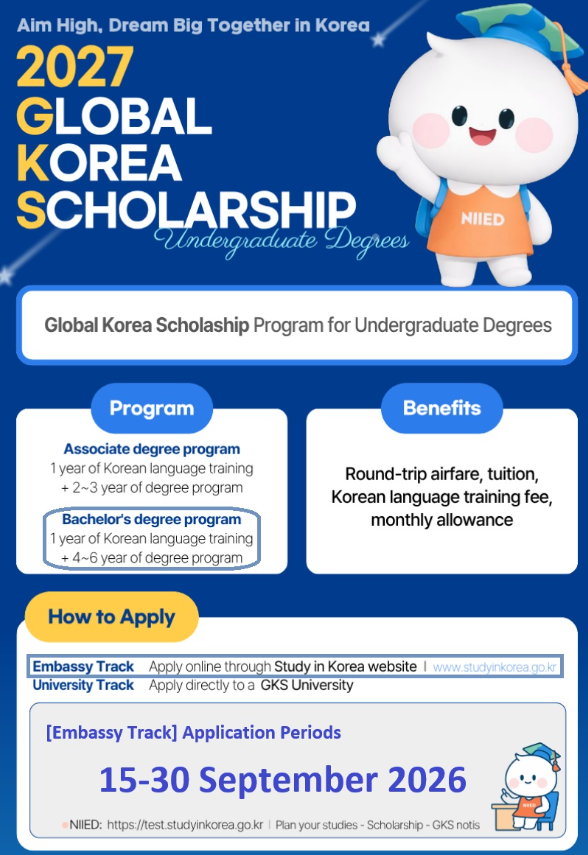
This is a long-term commitment. The full bachelor’s degree programme runs for 5 to 7 years, broken into two parts:
- 1 year of Korean language training
- 4 to 6 years of degree study, depending on your major
Before you apply, think honestly about whether you are ready for this length of time abroad. It is not a short exchange. It is most of your undergraduate life.
Key Dates
- Application period: 15 September to 30 September 2026
- Documents are not accepted after 30 September. The Embassy states this directly.
- Expected interview dates: 5 to 6 October 2026, at the Korean Embassy
- Interview language: English
- First selection results: sent through individual notification
Only applicants who are shortlisted will be contacted about their interview time. If you do not hear back, that generally means you were not shortlisted for that stage. The Embassy directs applicants to the full guidelines document for the complete detailed schedule.
How to Apply
Applications are accepted online only, through the Study in Korea website: studyinkorea.go.kr. There is no offline or paper submission option. You will need to create an account, complete the required information, and upload your documents through the site.
Full details on required documents are in the official application guidelines, which the Embassy has published alongside this notice. Read that document closely before you start.
The Apostille Rule: Read This Carefully
This is the part of the notice most worth slowing down for, because it differs from what some applicants might expect.
The Embassy states clearly: all documents are not required to have Consular confirmation (Attestation) by the Korean Embassy or Bangladesh’s Foreign Ministry at the time of initial submission.
However, there is a condition attached. If you pass the first round of screening, you will then need to submit original documents along with documents carrying Apostille verification, by a deadline the Embassy will set later.
In plain terms: you do not need your documents attested before you apply. But if you make it past the first cut, attestation becomes required at that point. This is different from some other GKS Embassy Tracks, where Apostille documents are needed right from the first submission. Do not assume the rule is the same everywhere, and do not attest documents you do not yet need to, since the Embassy has been explicit that this step comes later.
One More Rule Worth Repeating
Once you submit a document, the Embassy does not return it. Make sure every file you upload is complete, correctly filled out, and in good condition before you send it. There is no process to get a document back if you realise afterward that it was the wrong version.
Do Not Email About These Two Topics
The notice is unusually direct on this point. The Embassy asks applicants not to send inquiries about document attestation or letters of recommendation. It states plainly that it will not respond to such questions.
This matters practically. If you have a question in either of these two areas, emailing the Embassy will not get you an answer. Instead, the Embassy points applicants to the information notice and the FAQs guide, both of which it says cover the relevant details already. Read those documents fully before assuming you need to ask a question at all.
For anything genuinely not covered elsewhere, the contact email is: identitydhaka@mofa.go.kr.
A Practical Checklist Before You Apply
- Confirm you can commit to 5 to 7 years of study in Korea, including the language year
- Decide between the General and R-GKS tracks based on your eligibility
- Create your account on studyinkorea.go.kr early, not on the last day
- Read the full application guidelines and FAQs before preparing documents
- Do not get Apostille verification done yet unless you already know you need it; wait until you pass the first round and are asked
- Keep clean, final copies of every document, since nothing gets returned once submitted
- Avoid emailing about attestation or recommendation letters; check the guidance documents instead