
If you’re a high school student or recent graduate hoping to study in Korea on a full scholarship, this is the guide to start with. It covers who qualifies, how to apply, what documents you’ll need, what the scholarship actually pays, and what happens between applying and arriving in Korea.
Last Updated: 12 September 2026. NIIED has officially released the 2027 GKS Undergraduate Scholarship (GKS-U) Application Guidelines. The Embassy Track online application period runs from September 15, 2026 (11:00 KST) to September 30, 2026 (18:00 KST) through the Study in Korea website. University Track applications run from September to November 2026 with the exact period set by each university. This page reflects the confirmed 2027 guidelines.
Undergraduate GKS applicants face a different scholarship than graduate applicants do, even though both fall under the same program name. The age limit is tighter, the eligibility is based on secondary school rather than a completed degree, and there’s no research proposal in the mix.
How Undergraduate GKS Actually Differs From Graduate
| Criteria | Undergraduate | Graduate |
|---|---|---|
| Age Limit | Under 25 years | Under 40 years |
| Academic Basis | Completed secondary school (12 years of education) | Completed or expected bachelor’s/master’s degree |
| Extra Document | None required | Research Proposal (for research-track applicants only) |
| Typical Application Window | September–October | February–April |
The undergraduate track also tends to draw a very high volume of applicants relative to the number of available seats, since the age and academic requirements are broader by nature — more people finish high school each year than finish a specific graduate field. That makes early, careful preparation matter even more here, not less.
How Competitive Is the Undergraduate GKS Scholarship?
Undergraduate GKS is highly competitive because thousands of students from around the world apply every year for a limited number of scholarships.
While official acceptance rates vary by country and application cycle, successful applicants usually have:
- strong academic results
- a well-written Personal Statement
- a realistic Study Plan
- meaningful extracurricular activities
- clear reasons for studying in Korea
Selection committees evaluate the complete application rather than GPA alone. Strong essays and a coherent application often separate successful candidates from equally qualified applicants.
Are You Actually Eligible for GKS-U?
Work through these in order. A single miss on any of them typically means rejection at the document screening stage, regardless of how strong the rest of the application is.
- Citizenship: You and both your parents must hold non-Korean citizenship. Dual citizens with Korean nationality, including Korean-born adoptees who retained citizenship, aren’t eligible.
- Age: You must be under 25 as of the cutoff date announced for the cycle. For the 2027 intake, this means born after March 1, 2002.
- Academic completion: You must have completed, or be on track to complete, all 12 years of secondary education before your program’s enrollment date.
- Current enrollment restriction: Applicants currently enrolled in a Korean high school are not eligible for this track.
- Academic performance: A cumulative GPA of roughly 80% or higher, or a class rank in the top 20% — NIIED reviews borderline GPAs against class rank rather than applying a single rigid number.
- Health: Applicants must be in good physical and mental health, confirmed through a medical examination as part of the process.
- You can check detailed GKS Scholarship 2027 Undergraduate Eligibility Criteria here.
If you’re unsure whether your grading system converts cleanly to these thresholds, don’t self-disqualify based on a rough estimate — NIIED applies its own conversion tables by country, and a borderline case is often still worth applying.
How to Apply for the GKS Undergraduate Scholarship
The process runs in roughly this order, though your exact steps depend on which track you choose.
- Confirm your eligibility against the criteria above.
- Choose your track — Embassy or University (covered below).
- Choose your universities, following your track’s selection rules.
- Gather your required documents (next section).
- Write your Personal Statement and Study Plan — these take real time, so start early.
- Submit your application by the deadline. Embassy Track applications go online through the Study in Korea website. University Track applications are typically submitted in person or by post, directly to your chosen university.
- Wait for document screening results. Only shortlisted applicants are contacted.
- Attend your interview, if you’re shortlisted.
- Wait for the final selection announcement.
- Confirm your acceptance by the stated deadline, then begin visa and document preparation.
Step 6 catches people off guard most often: the two tracks don’t use the same submission method, so confirm which applies to you before assuming everything happens on one website. If you still do not understand how to apply, then check our detailed guide on GKS Scholarship 2027 Application Process (Full Step by Step Guide)
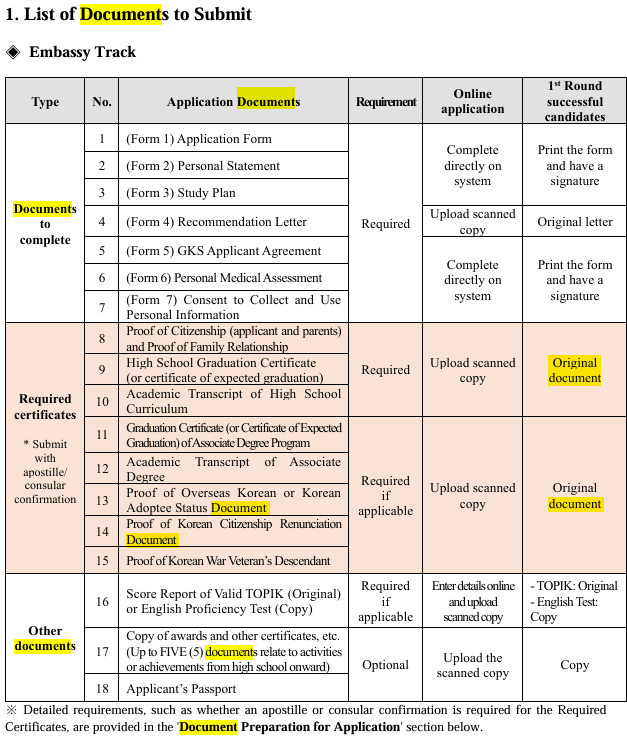
Required Documents for GKS-U Scholarship 2027
Every applicant submits broadly the same document set, though your embassy or university may request extras.
- Application form — your basic personal, academic, and program information
- Personal Statement — covered in full in its own guide
- Study Plan — covered in full in its own guide
- Academic transcripts — your full secondary school record
- Certificate of graduation or expected graduation — if you haven’t graduated yet, this substitutes temporarily, but your final diploma is still required by a set deadline once available
- Recommendation letter — typically from a teacher, principal or department chair who can speak to your academic ability
- Passport copy — for identity and citizenship verification
- Medical health status form — a self-certification of general health
- GKS scholarship pledge and consent forms — administrative agreements required by NIIED
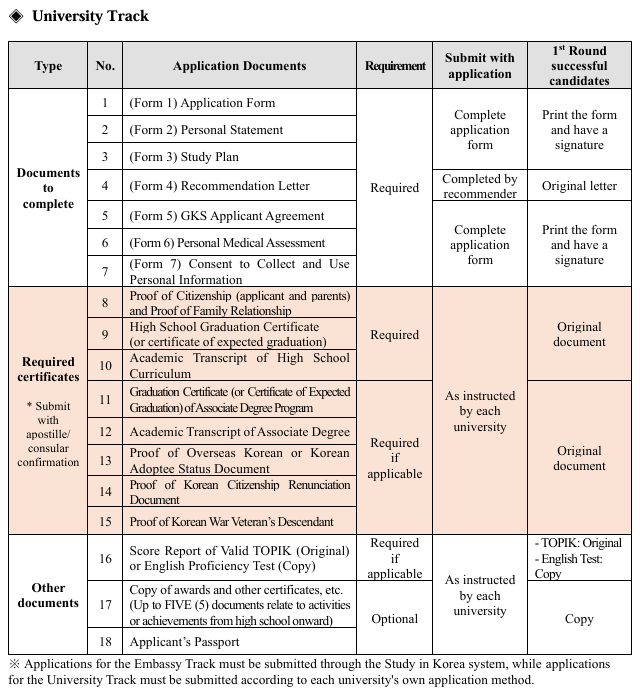
If you’re applying as an “expected graduate,” don’t treat that as the end of the paperwork — most cycles still require your official diploma and final transcript to be submitted to NIIED by a hard December deadline, even after you’re selected.
GKS Scholarship 2027 Documents Apostille Authentication
- Document authentication is an important part of the GKS 2027 application.
- For the first Embassy Track round, you upload scanned copies of your documents through the Study in Korea system.
- If you pass the first round, you will later need to submit the original required documents for NIIED’s second-round evaluation.
- Documents issued in English or Korean generally need to be apostilled or consular confirmed.
- If your documents are in another language, you must provide a certified translation.
- The original document or its certified translation must also have the required authentication.
- A simple photocopy or normal notarized copy of an apostilled document cannot replace the properly authenticated document.
- If the authenticated document does not mention an expiration date, it will generally be accepted when submitted within 2 years from the date of authentication.
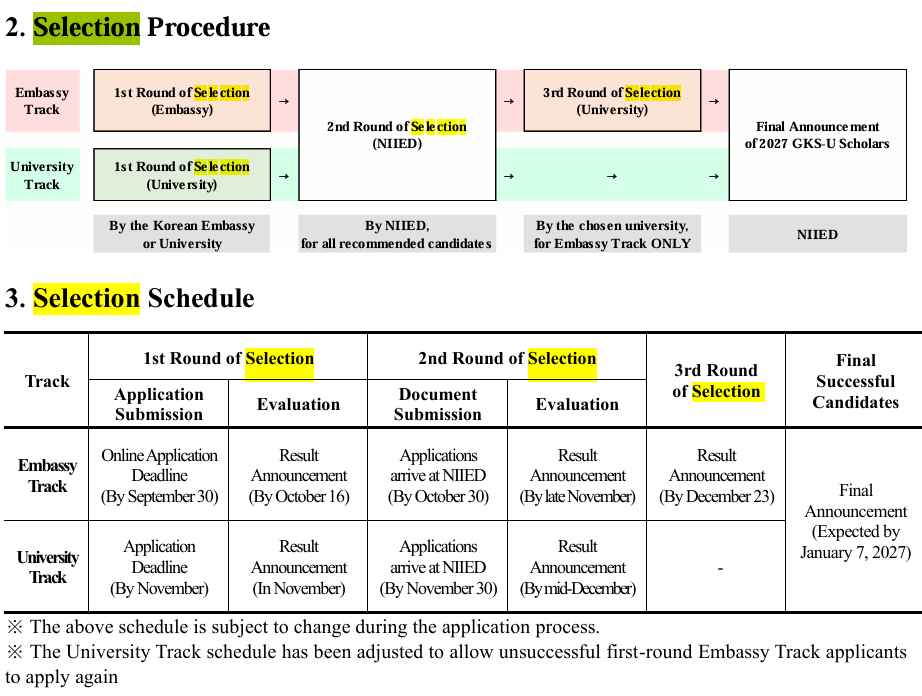
GKS-U 2027 Application Timeline
| Stage | 2027 Cycle Date |
|---|---|
| Application Guidelines Announced | September 2026 |
| Embassy Track Online Application | Sept 15, 2026 (11:00 KST) – Sept 30, 2026 (18:00 KST) |
| University Track Application | September–November 2026 (varies by university) |
| 1st Round Results — Embassy Track | By October 16, 2026 |
| 1st Round Results — University Track | November 2026 |
| 2nd Round Results (NIIED) — Embassy Track | Within November 2026 |
| 2nd Round Results (NIIED) — University Track | Within December 2026 |
| 3rd Round Results — Embassy Track only | By 6pm, December 23, 2026 |
| Final Selection Announced | Expected January 7, 2027 |
| Invitation Letters Sent | Within January 2027 |
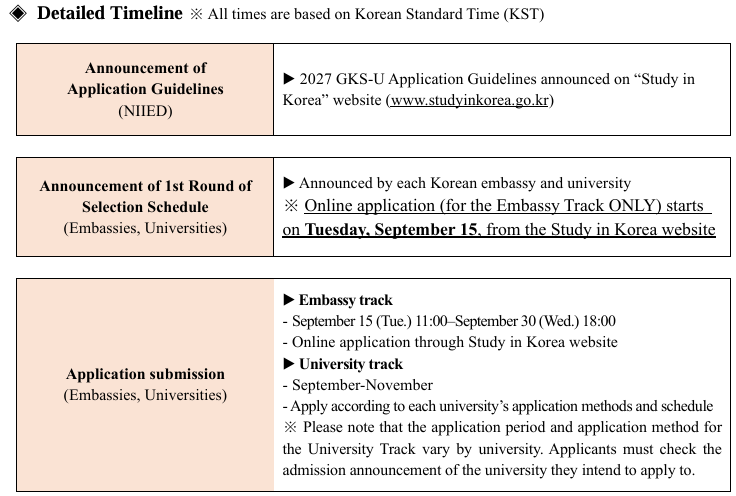
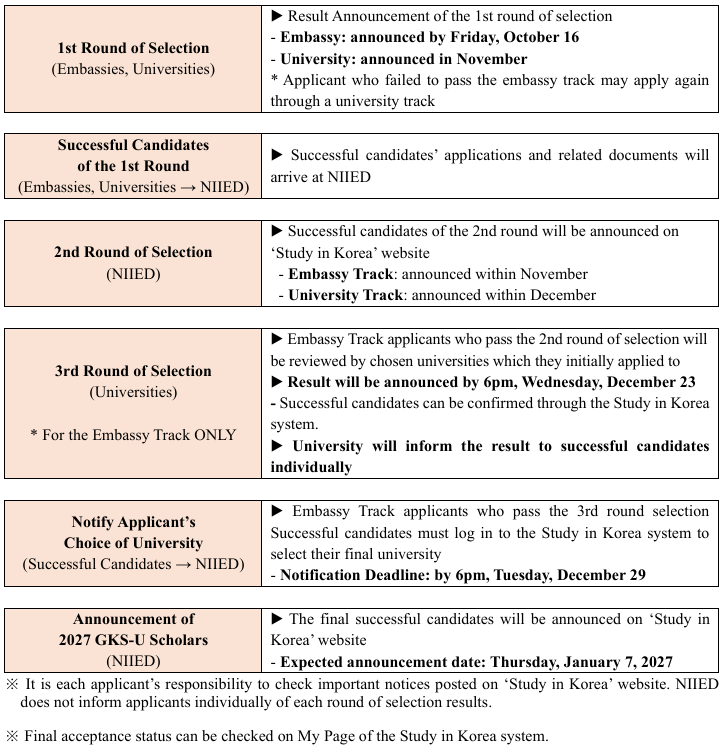
Exact dates shift every cycle. Treat this as the shape of the year, not a fixed calendar — always confirm against your embassy’s or university’s current notice.
What the Scholarship Actually Pays For
Figures shift slightly between cycles, so treat these as a working reference rather than a guarantee — always confirm against the current year’s official notice.
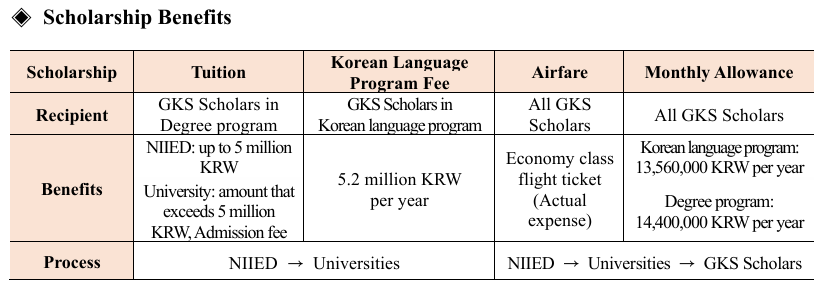
| Benefit | Typical Amount |
|---|---|
| Tuition | 100% covered — NIIED covers up to 5,000,000 KRW per semester while the university covers any excess plus the admission fee. |
| Korean Language Program Fee | 5,200,000 KRW per year, covered separately from the monthly stipend. |
| Monthly Stipend (Language Year) | Approximately 1,130,000 KRW per month (13,560,000 KRW/year). |
| Monthly Stipend (Degree Program) | Approximately 1,200,000 KRW per month (14,400,000 KRW/year). |
| TOPIK Bonus Stipend | An extra monthly allowance for scholars who achieve TOPIK Level 5 or Level 6. |
| Airfare | Economy class flight ticket (actual expense), both to and from Korea. Entry airfare is NOT provided to scholars already residing in Korea at the time of selection. |
| Health Insurance | Covered for the full scholarship period. |
The stipend difference between the language year and the degree program is a detail many applicants don’t expect — both years are funded, but not at an identical rate.
GKS Scholarship Undergraduate Quota
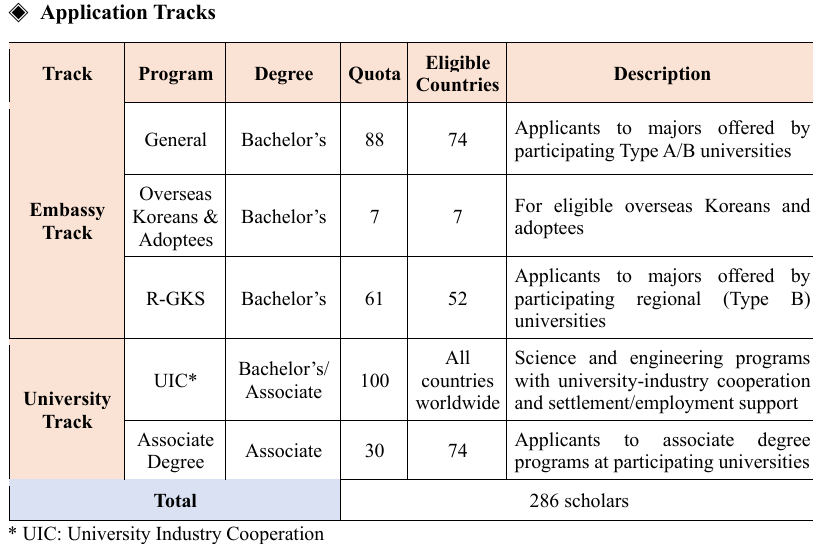
For the 2027 intake the GKS Undergraduate Scholarship will give 286 scholarships to outstanding international students pursuing Associate and Bachelor degree programs in South Korea. Among these 156 candidates will be picked through the Embassy Track while the remaining 130 students will be admitted via the University Track. This gives applicants two paths to secure this top fully funded scholarship.
Choosing Your Track
Undergraduate applicants use the same two main paths as graduate applicants: Embassy Track, where you rank up to three university preferences through your home country’s Korean embassy, and University Track, where you apply directly to one university and department.
The core mechanics — including the Type A/Type B mix requirement under Embassy Track — work the same way at the undergraduate level as they do at the graduate level. If you haven’t decided between the two yet, it’s worth reading the full track comparison before committing.
GKS Embassy Track Quota
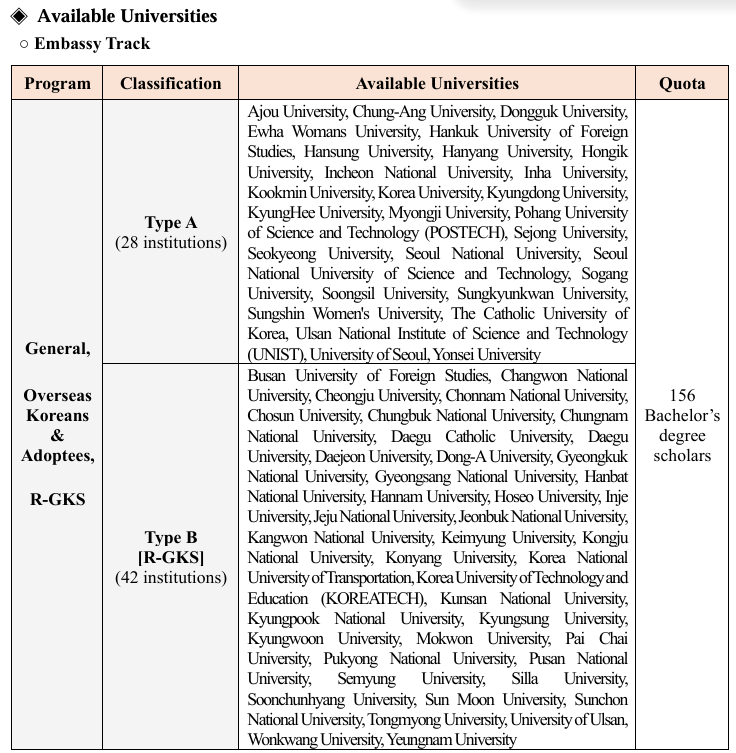
A total of 156 scholarships are available under the Embassy Track. Each participating country has its own scholarship quota.
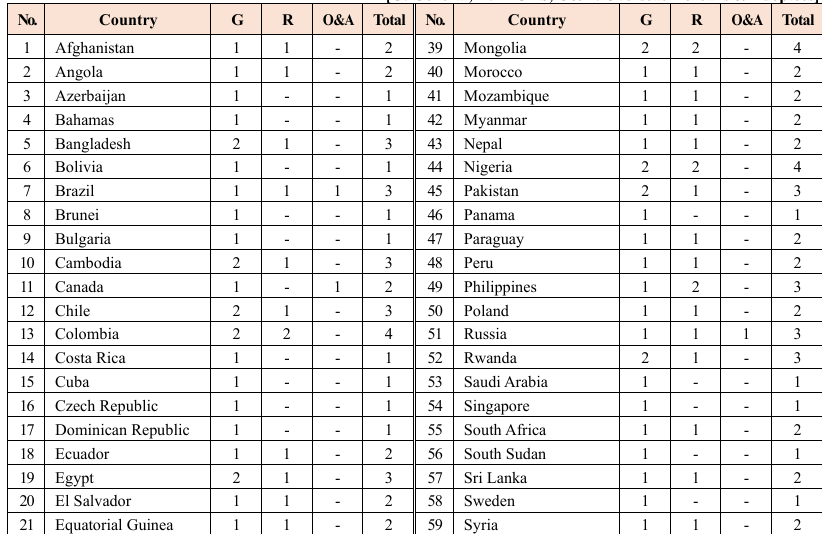
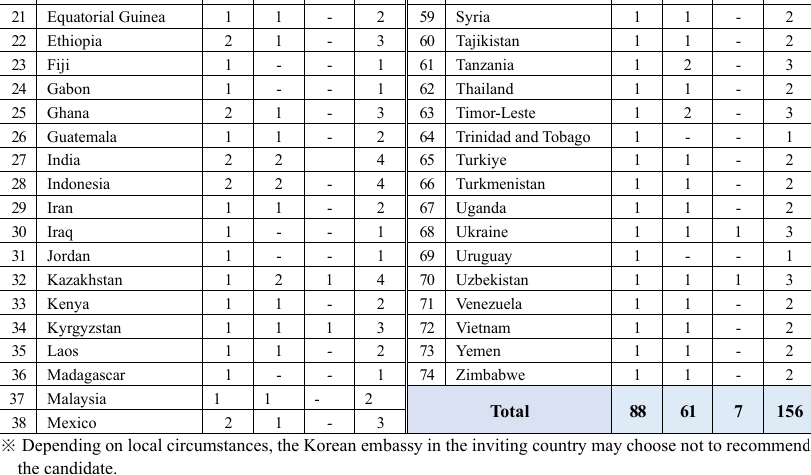
- General Program: 88 scholarships from 74 countries
- Overseas Koreans Program: 7 scholarships
- R-GKS Program: 61 scholarships for students from 52 countries
Total Embassy Track Scholarships: 156
GKS University Track Quota
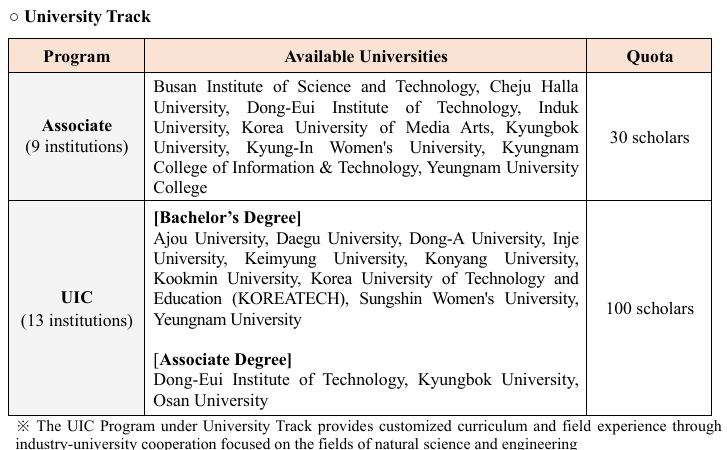
A total of 130 scholarships are available under the University Track.
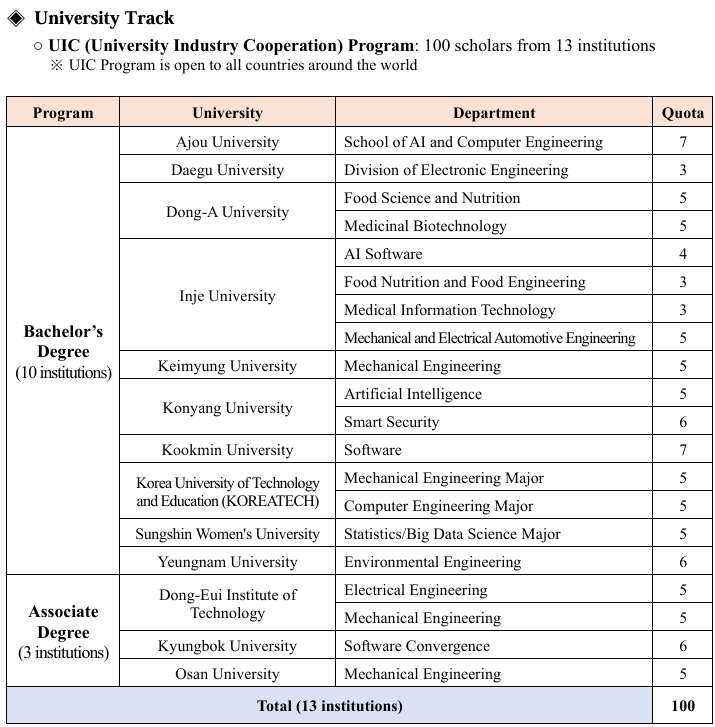
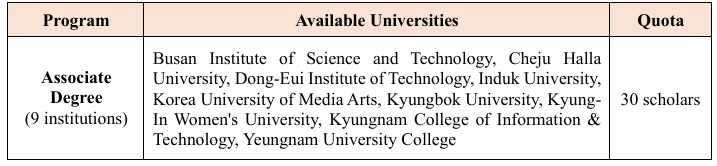
Associate Degree Program: 30 scholarships for students from 74 countries, 9 Institutions
University Industry Cooperation (UIC) Program: 100 scholarships
Note: The UIC Program is open to applicants from all countries around the world.
How to Choose Between Embassy and University Track
Many first-time applicants assume one track is always better than the other. In reality, the best choice depends on your application strength and university preferences.
Embassy Track is usually better if:
- You want up to three university choices.
- You have strong academic records and extracurricular activities.
- You are comfortable competing in a larger applicant pool.
University Track may be a better choice if:
- You already know which university you want.
- Your chosen department closely matches your academic background.
- You prefer applying directly to one institution.
Before making a final decision, compare both tracks carefully because the application process, competition level, and university selection rules are different. Check Complete Guide to GKS Embassy Track vs University Track.
Choosing Your Universities
Once you’ve picked a track, you still need to choose which specific universities to apply to. Under the Embassy Track’s General and Overseas Koreans & Adoptees programs you may choose up to three universities and at least one of your three choices must come from the Type B category. Under the R-GKS program specifically, you may choose up to two universities, both of which must be Type B.
Choosing well means weighing your actual field against each university’s program, not just picking recognizable names. The complete GKS Universities Guide covers Type A versus Type B, how to combine choices strategically, and where to find the current official list.
How to Improve Your Chances of Selection
None of these guarantee selection, since GKS is genuinely competitive — but each one moves the odds in your favor.
- Get a TOPIK score, even a modest one. Applicants with TOPIK Level 3 or above receive additional evaluation points (roughly 3% of total score at Level 3, rising to 5% at Level 5 or above) so waiting until you’re “ready” to test costs you points you could already have.
- Don’t wait on GPA to fix itself. If your grades are borderline, a strong class rank and a clear upward trend can help — but the earlier you know where you stand, the more you can do about it.
- Show real extracurricular or community involvement, not just a list of memberships. One or two activities described specifically are more convincing than five described vaguely.
- Choose universities strategically, not by prestige alone. A well-matched Type B program often beats a poorly-matched Type A one in both fit and odds.
- Give your Personal Statement and Study Plan real time. These are the two documents reviewers weigh most heavily — rushed versions are usually easy to spot. Both may be written in English or Korean.
- Prepare for your interview before you’re shortlisted, not after. Knowing your own documents well enough to speak to them naturally takes more practice than most applicants expect.
GKS English Language Proficiency Points
- GKS checks Korean and English language scores separately.
- For Korean, GKS accepts TOPIK scores.
- For English, GKS accepts TOEFL iBT and IELTS scores.
- Your language score can give you different points during the 2027 evaluation.
| Evaluation Level | TOPIK | TOEFL iBT Before Jan 21, 2026 | TOEFL iBT From Jan 21, 2026 | IELTS |
|---|---|---|---|---|
| 100% | Level 5 or above | Not specified | Not specified | Not specified |
| 90% | Level 4 | 114+ | 6.0 | 8.0+ |
| 80% | Level 3 | 95+ | 5.0+ | 7.0+ |
| 70% | Level 2 | 72+ | 4.0+ | 6.0+ |
| 60% | Level 1 | 42+ | 3.0+ | 5.0+ |
| 50% | No official score | — | — | — |
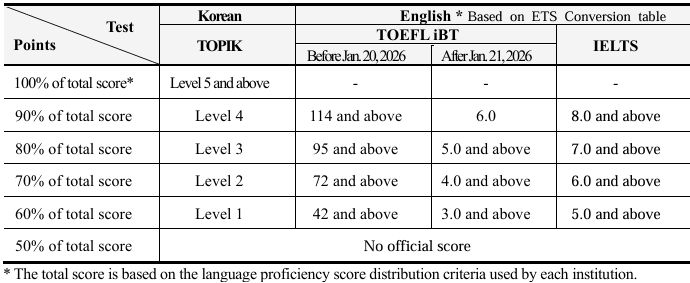
- The 2027 GKS guidelines also consider the new TOEFL iBT scoring system for tests taken from January 21, 2026 onward.
- If you submit more than one language test score, GKS will consider only your highest score.
Official Resources
Always confirm details against NIIED’s own materials rather than relying on any third-party guide, including this one, for exact dates or figures.
- Study in Korea website (studyinkorea.go.kr) — the official application portal for Embassy Track and the source for each cycle’s GKS Notice
- GKS Notice board — published under Scholarships on the Study in Korea website, where the current year’s guidelines, forms, and university list are posted
- NIIED contact — gksniied@korea.kr, for questions the official guidelines don’t answer directly
- Your local Korean embassy or consulate — for Embassy Track applicants, the direct point of contact for country-specific instructions
Questions Undergraduate Applicants Actually Ask
Should I apply now, or finish my current degree first?
Some students already partway through a degree elsewhere weigh whether to apply now and restart in Korea if selected, or wait. There’s no universal right answer — it depends on how many years you’d effectively restart, and how strongly you want the specific program in Korea. Weigh it deliberately rather than defaulting to either option.
Do I have to already speak Korean?
No. Most undergraduate scholars go through the same mandatory year of Korean language training as graduate scholars, unless they already hold TOPIK Level 5 or 6 in which case the language year is waived entirely and the degree program begins directly.
Can I work part-time while studying?
Generally yes, once you’ve completed the language program and have the appropriate visa endorsement — typically up to 20 hours per week during the semester and full-time during vacations, subject to immigration rules at the time.
Do I need a research proposal?
No. That requirement applies to graduate research-track applicants, not undergraduates.
Myths That Trip Up Undergraduate Applicants
“Undergraduate is the easier track since the requirements are broader.” Broader eligibility means a larger applicant pool, not lighter competition. Relative to available seats, undergraduate GKS is often just as competitive as the graduate tracks, sometimes more so.
“I can’t apply until I’ve officially graduated high school.” You can apply while completing your final year, as long as you’ll finish before enrollment. Waiting until after graduation to even start preparing documents often costs valuable preparation time.
“A slightly low GPA automatically disqualifies me.” A borderline GPA is reviewed against class rank, not rejected outright. It’s worth applying and letting the review process weigh both figures together.
“The scholarship only covers my first year, then I’m on my own.” Both the language year and the full degree program are funded, including tuition, stipend, and insurance throughout — not just an initial period.
Final Eligibility Checklist
- Confirmed you and both parents hold non-Korean citizenship
- Confirmed your birth date falls after the current cycle’s cutoff (March 1, 2002 for the 2027 intake)
- Confirmed you’ll complete secondary school before enrollment, and aren’t currently enrolled in a Korean high school
- Checked your GPA or class rank against the roughly 80%/top-20% threshold
- Gathered documentation for a medical health certification
- Decided between Embassy Track and University Track
- Reviewed the current official university list for your chosen track
GKS Undergraduate Scholarship GPA Conversion Table

Frequently Asked Questions
Is the undergraduate application process different from graduate in terms of documents?
Mostly similar — Personal Statement, Study Plan, transcripts, recommendation letter, and consent forms are required across both. The main difference is the absence of a Research Proposal at the undergraduate level.
What happens if my birthday falls right around the age cutoff?
The exact cutoff date is set and published each cycle. If you’re close to the line, check the specific date in the current year’s official guidelines rather than relying on a general “under 25” estimate.
Are undergraduate programs taught in English or Korean?
Both exist, and it varies by university and department. This is worth confirming directly for each university you’re considering, since it affects both your Study Plan and your day-to-day coursework.
Does TOPIK matter if I’m just starting to learn Korean?
Yes, even at an early level. TOPIK Level 3 or above earns additional evaluation points.
If you’re planning to apply for the GKS Scholarship 2027, your next step is preparing every part of your application carefully. Start with your Personal Statement and Study Plan, understand the differences between the Embassy Track and University Track, review the required documents, and research eligible universities before the application window closes on September 30, 2026 (Embassy Track).
Recommended next guides:

I want to apply for gks as i have a plus 2 subject with major English with health can i apply athletic as a health student i have been training here for year’s but of bad economic conditions i can’t give a good performance so i want to go korea and get it
I want to study in korean I have try but my age please help me am done with high school here in Nigeria
Do i need to authenticate my docs for the first online application?
when would application open officially?
When we can apply for 2027 in 2026
Hey i want to apply for the scholarship how can i do please
Am a scine student
Yes, you can apply if you meet the GKS Undergraduate eligibility requirements. As a science student, you may have suitable options. You can check our step-by-step application guide here:
https://gksscholarships.com/how-to-apply-for-gks-scholarship-kgsp/
When we can apply for 2027
The 2027 GKS application dates will depend on the program and track. The expected opening date for the GKS-U 2027 application is September 15, 2026. We’ll share the official dates once announced so you can bookmark our site for updates.
Can I apply for a scholarship in south Korea but I don’t have A level can I get a foundation if possible
Yes, you may still have options without A Levels. GKS undergraduate eligibility depends on your completed high-school qualification. Foundation options also depend on the university.
I want study in Korea . When would Application open officially ?
The official application period depends on the GKS program and track. We’ll share the official opening date and deadline once announced so you can bookmark our site for updates.
How can I apply from university track I am confused ?
And when will the addmission open
For the University Track, you apply directly to a participating Korean university. The opening date depends on the university so check the latest GKS announcement and university deadline.
I need to apply this scholarships and inform me by my email address
I want to study in Korea
Hey, I wish I could be in Korea and continue my education there if I have have chance. I have hope that one day I will find achance if God accept it
I have a interested in studying B.pharmacy in Korea and I have try may best be still lcan not make please l have a help
Sure, I can help. Please share your country and education level, and I’ll guide you.
Thank you so much for the response!
Could you please clarify what high-school qualifications are accepted for GKS-U if I only have O-Levels?
And are there specific universities under GKS that offer foundation programs for students without A-Levels?
Thank you for your guidance.
Thank you so much for the response!
Could you please clarify what high-school qualifications are accepted for GKS-U if I only have O-Levels?
I’m from Zimbabwe
Thank you for your guidance.
I’m from Malawi ,yes indeed I want to in Korea
I am in Congo, this opportunity is really important to me. Hello, I am very interested.
I would to study in Korea
I’m from India, Mysore
Yes I need a scholarship
to I’m graduating
I want to in Seoul
I would live to study in Korea
I’m North of Pakistan Skardu
I need this scholarship plz
I want a GKS scholarship
i want to study in korea and iam in my 12th and will write exams in February 2027
i want to study in korea and iam in my 12th and will write exams in February 2027 my dream is to study in korea
I want to study in Korea because korean study was very good
And i love Korea
Still I am in 12th class i would love to come Korea and study there
Please sir or ma, I would like to study in Korea, but am really confused with the university track and all, please can you guide me through.
I want to apply for masters sccholarship in Korea in 2027 how can i do that by embassy track and need all document details. Kindly guide