


Most scholarship headlines say “open to African students.” This one is more specific and that matters before you spend time on an application.
The GeoAI for Land Systems Science partnership has announced seven full scholarships for master’s study at the University of Copenhagen in Denmark. The program runs 22 months and starts in September 2027. The deadline is 15 November 2026.
The call is aimed at students enrolled at the University of Rwanda (UR) or the University of KwaZulu-Natal (UKZN) in South Africa. If you study elsewhere, check the official call before assuming you are eligible.
At a Glance
Last Information Checked: 23 October 2026
| Detail | Information |
| Program | GeoAI for Land Systems Science |
| Host University | University of Copenhagen, Denmark |
| Partner Universities | University of Rwanda, University of KwaZulu-Natal |
| Level | Master’s degree (plus exchange opportunities) |
| Awards in 2027 Call | 7 full scholarships |
| Duration | 22 months |
| Start Date | September 2027 |
| Deadline | 15 November 2026 |
| Funder | Danida Knowledge & Innovation Programme, 2026 to 2032 |
Who This Call Is Really For
The scholarships are tied to the partnership between three universities. Students at UR and UKZN are the named audience.
That is a smaller pool than the headline suggests, which is good news if you do qualify. Seven awards shared between two partner universities is a far narrower field than an open global competition.
Not sure where you stand? Read the official call for the exact number of awards available to your institution and the program-specific rules.
What You Would Study
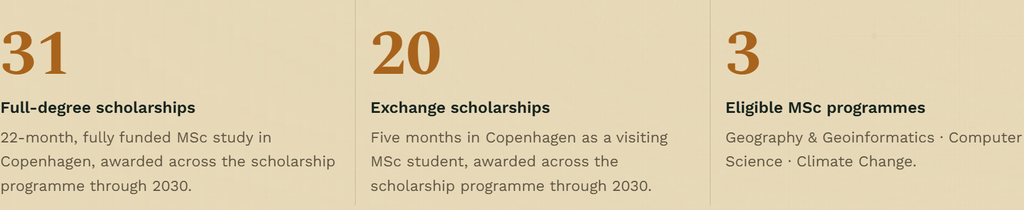
The partnership connects to three existing master’s programs at Copenhagen:
- Geography and geoinformatics
- Computer science
- Climate change
Which one you can apply to depends on the official call and the admission requirements. The partnership is aimed at students interested in remote sensing, climate science, geography, computer science, and artificial intelligence.
The Idea Behind GeoAI
Geospatial AI sounds technical but the problem it addresses is practical. Land across Africa and other regions faces pressure from climate change, deforestation, land degradation, biodiversity loss, and food insecurity.
Managing those problems needs reliable data. GeoAI combines artificial intelligence with satellite imagery, remote sensing, and geographic information systems. Researchers can then track how landscapes change and make better decisions about land use.
The partnership aims to build research capacity, develop new teaching programs, support academic mobility, and create lasting networks between Africa and Europe.
Two Types of Scholarship
Full-degree scholarships support master’s study at Copenhagen. The 2027 call advertises seven of these, each covering a 22-month study period starting in September 2027.
Exchange scholarships are the second category. The source material for this article breaks off before describing them, so no details are confirmed here. Check the official call for eligibility, duration, and what each exchange award includes.
Over the longer term, the partnership plans 51 scholarships through 2030: 31 full-degree awards and 20 exchange awards for eligible students from Rwanda and Southern Africa.
About the Funding
The scholarship is described as “full,” but the published material does not list the individual items. Tuition, living costs, travel, and insurance could each be covered or not.
Read the official funding terms before you make plans. Do not assume any benefit that isn’t written there.
Denmark’s cost of living is high, so the exact monthly support will matter. Look for it early in the official documents.
Your Next Steps Before 15 November
With 23 days left, the order of tasks matters.
- Confirm your institution. Check that you are enrolled at UR or UKZN, or that the official call allows your situation.
- Read the full call at geoai4landscience.org. Note the number of awards for your university and the program-specific requirements.
- Choose your master’s program from the three options (geography and geoinformatics, computer science, or climate change).
- Gather your documents. The source does not list them, so use the official checklist.
- Submit early. Don’t wait for the last day, especially if you are uploading from a slow connection.
