

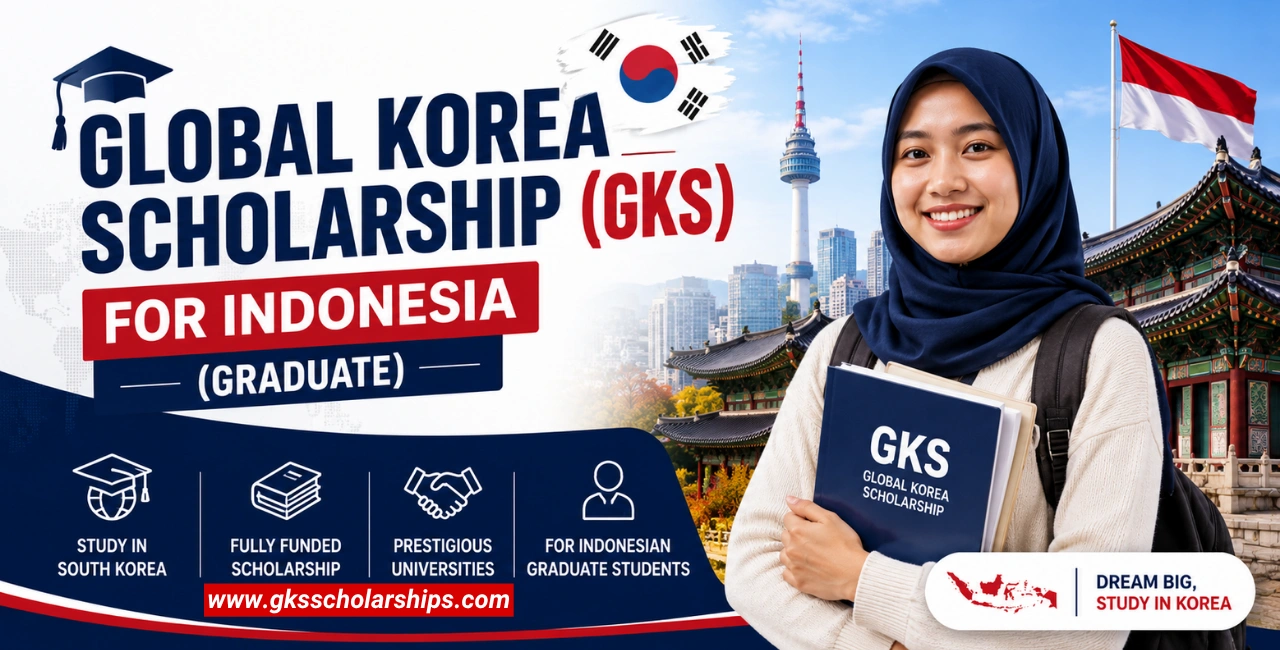
South Korea funds graduate students from 146 countries every year through the Global Korea Scholarship. Indonesia is one of the program’s largest recipient countries, with dedicated quotas allocated through two separate application tracks.
For Indonesian students aiming for a fully funded Master’s or PhD in Korea, understanding how those two tracks work — and which one fits your situation — is the most important decision you’ll make before applying.
GKS Scholarship for Indonesia Overview
| Detail | Information |
|---|---|
| Scholarship | Global Korea Scholarship (GKS) — Graduate Degree |
| Funder | Korean Government (NIIED) |
| Target | Master’s and PhD students |
| Countries | 146 countries including Indonesia |
| Total Annual Slots | Approximately 1,300 students globally |
| Indonesia Embassy Track | ~27 slots (varies by cycle) |
| Indonesia University Track | ~42 slots (varies by cycle) |
| Application Route | Embassy Track or University Track |
What the Scholarship Covers
GKS is a comprehensive funding package. It doesn’t just cover tuition — it covers the full cost of studying and living in Korea for the duration of your degree.
The scholarship includes:
- Round-trip airfare (economy class, Korea and home country)
- Full tuition fees paid directly to the university
- Monthly living stipend throughout the program
- Settlement allowance upon arrival in Korea
- Korean language training expenses (pre-degree language program)
- Medical insurance coverage
- Scholarship completion grant at the end of the program
The Korean language training component is worth highlighting separately. Most GKS recipients spend one year studying Korean before beginning their actual degree program — fully funded. This means the total funded period is longer than just the Master’s or PhD duration itself.
Two Tracks, Two Very Different Processes
Indonesian students can apply through one of two pathways. They work differently, and the distinction matters.
The Embassy Track
Applications go directly to the Korean Embassy in Jakarta. The embassy reviews submissions, shortlists candidates, conducts interviews, and forwards selected applicants to NIIED (the National Institute for International Education) in Korea.
Embassy Track applicants submit physical documents by courier to the Embassy address in Jakarta. Email and fax submissions are not accepted. The embassy allocates a fixed quota for Indonesia each cycle — approximately 27 slots in recent years, though this figure changes annually.
Shortlisted candidates are typically interviewed online. Only candidates who pass the shortlisting stage are notified of their interview schedule.
The University Track
This track bypasses the embassy and allows applicants to apply directly to participating Korean universities. The university evaluates candidates and nominates them to NIIED for scholarship consideration.
The University Track generally offers more slots for Indonesian students than the Embassy Track — approximately 42 in recent cycles. It also allows applicants to target specific universities and programs directly, which can be advantageous if you have a clear research focus or a specific supervisor in mind.
The application process, required documents, and deadlines differ between tracks. Check both before deciding which route fits your situation.
Who Can Apply
GKS Graduate Degree scholarships are open to applicants who:
- Hold Indonesian citizenship (applicant and both parents must hold non-Korean citizenship)
- Have completed an undergraduate degree or will complete one before the program begins
- Meet the age requirements specified in the current cycle’s guidelines
- Are in good health
- Have not previously received a Korean Government Scholarship
For the Embassy Track specifically, applicants must submit a copy of their Kartu Keluarga (KK) as proof of family citizenship status. Documents issued in languages other than Korean or English must include a complete translation into one of those languages alongside the original.
The Application Package — What You’ll Need
The GKS application is document-heavy. Preparing everything correctly before submission matters — once the online form is submitted, data cannot be edited.
Typical documents required:
- Completed GKS application forms (download from official portal)
- Personal statement
- Study plan
- Recommendation letters (usually two, with one original required)
- Official undergraduate transcripts and degree certificate
- Language proficiency certificates (if applicable)
- Medical certificate
- Copy of passport
- Copy of Kartu Keluarga (KK)
- Any awards or research publications (if applicable)
Document formatting rules for the Embassy Track:
All documents must be submitted in A4 format. Documents smaller than A4 should be attached to a blank A4 sheet. Documents larger than A4 should be photocopied or folded to A4 size. Label each document clearly and number them according to the application checklist.
Submit everything in a single envelope. The embassy will not accept documents sent separately.
Successful candidates are typically required to resubmit apostilled documents within a specified deadline after selection — usually within a few weeks of results. Budget time and cost for apostille processing when planning your application timeline.
Five Things Indonesian Applicants Consistently Get Wrong
Most GKS rejections in the Embassy Track come down to avoidable mistakes. These come up repeatedly.
1. Missing the physical submission deadline. The embassy does not accept applications after the stated deadline, without exception. Factor in courier transit time — submitting on the final day via same-day delivery is a risk not worth taking.
2. Editing the online form after submission. The GKS online application form locks upon submission. Information entered must match the physical documents exactly. Complete the form only after all documents are finalized.
3. Sending documents by email or WhatsApp. Only courier services (JNE, Kantor Pos, DHL, and equivalents) are accepted. Email and fax submissions are rejected.
4. Submitting documents in multiple envelopes. Everything goes in one envelope. Separate document submissions are not accepted.
5. Ignoring the translation requirement. Any document not in Korean or English must be accompanied by a full translation. Partial translations or summary translations are not sufficient.
University Selection — How It Works
Embassy Track applicants typically select preferred universities and programs as part of their application. Applicants may indicate multiple preferences, which NIIED and the universities consider during the placement process.
The final university placement is not entirely within the applicant’s control. NIIED coordinates placements based on program availability, language proficiency, and academic fit.
University Track applicants have more direct control over their university placement, since they apply to specific institutions directly. This makes the University Track attractive for candidates with a clear research direction or existing contact with Korean faculty.
After You Apply — The Selection Timeline
The GKS selection process runs across several months between the application deadline and the final announcement. Based on previous cycles, the sequence typically includes:
- Application submission deadline
- Embassy-level document review and shortlisting
- Online interviews for shortlisted candidates
- Submission of shortlisted applications to NIIED
- NIIED review and final selection
- University placement coordination
- Final results announcement
- Apostilled document resubmission by selected candidates
- Pre-departure orientation and Korean language program
Specific dates change each cycle. The current cycle’s official timeline is published on the StudyInKorea portal and in the embassy’s announcement documents.
Applying for the Current Cycle
Each new GKS cycle brings updated quotas, revised deadlines, and sometimes modified document requirements. Information from previous cycles — including this guide — should be treated as background context rather than current instructions.
Before applying, verify directly:
- Current quota allocation for Indonesia (Embassy and University Track)
- Submission deadline for the current cycle
- Updated application forms (download fresh copies from the official portal — do not reuse forms from previous years)
- Current interview schedule
- Any changes to eligibility criteria or required documents
Official sources:
- StudyInKorea portal: www.studyinkorea.go.kr
- Korean Embassy in Jakarta: JL. Gatot Subroto Kav. 57, Jakarta 12950
- Tel: 021-2967-2555
The embassy announcement for each cycle is the authoritative document. If anything in a social media post or third-party guide contradicts the official announcement, the official announcement takes priority.
