
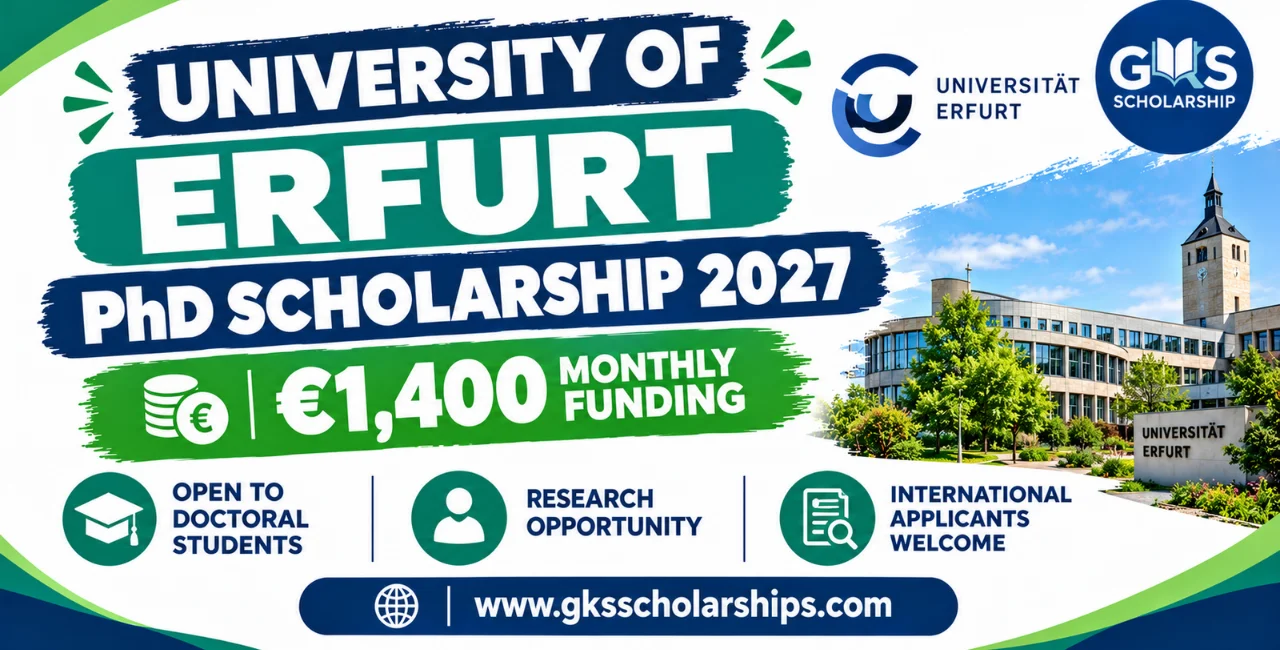
Most doctoral scholarships in Germany come with a long list of vague eligibility rules and an even longer wait for a decision. The University of Erfurt’s newest funding round is refreshingly specific about both. Up to four candidates will receive a fully funded PhD scholarship in Germany for 2027 and the university has laid out almost every requirement in detail. That is good news for applicants but it also means there is no room to skip steps.
Here is what this Erfurt PhD Scholarship in Germany 2027 opportunity actually involves and what your application needs to include to be taken seriously.
At a Glance
| Detail | Information |
|---|---|
| University | University of Erfurt Germany |
| Programme | Erfurt Doctoral and Postdoctoral Programme (EPPP) |
| Funding source | Thuringian State Graduate Support |
| Number of awards | Up to 4 |
| Monthly stipend | €1400 basic |
| Family allowance | €300 first child €150 each additional |
| Duration | 3 years possible 1-year extension |
| Start of funding | 1 April 2027 latest 1 July 2027 |
| Application deadline | 24 November 2026 |
What This Scholarship Actually Is
This funding comes through the Thuringian State Graduate Support programme, channeled specifically into the University of Erfurt’s Erfurt Doctoral and Postdoctoral Programme known as EPPP. It supports doctoral candidates whose research is hosted within one of the university’s certified Graduate Centres or the Max-Weber-Kolleg.
Funding begins on 1 April 2027 and the application deadline is 24 November 2026 at 11:59 p.m. CET.
What the PhD Funding Actually Covers
This is a genuine PhD stipend Germany program, not just a fee waiver. Successful scholars receive:
- €1400 per month as the basic scholarship
- €300 per month for a first dependent child
- €150 per month for each additional dependent child
- Up to €600 per funding year for research-related materials and travel, subject to approval
- A standard three-year funding period with the possibility of a one-year extension
What You Are Expected to Do in Return
Funding comes with real obligations. Scholarship holders must actively participate in their Graduate Centre or Max-Weber-Kolleg programme, attend at least six academic skills training courses and engage in academic networking throughout the funding period.
There is also a checkpoint built into the timeline an 18-month progress report on your doctoral research project which the university uses to track how your work is developing against your original plan.
Eligibility Requirements
The eligibility bar here is specific and several requirements need to be satisfied before the funding period even starts, not just before you apply.
To qualify, you must:
- Have above-average academic achievements and examination results showing genuine aptitude for academic research
- Be accepted as a doctoral candidate by one of the University of Erfurt’s faculties or by the Max-Weber-Kolleg at the latest by the start of funding
- Be matriculated at the University of Erfurt and hold full membership in the relevant Graduate Centre or Max-Weber-Kolleg by the funding start date
- Provide proof of current health insurance
- Comply with the university’s rules on other sources of income or funding
That matriculation requirement is worth flagging early. You do not need to already be enrolled when you submit your application but you do need to be fully enrolled and a member of your chosen Graduate Centre by the time the funding actually begins. That process takes time so it needs to start well before the November deadline not after you hear back.
Employment Rules While You Hold the Scholarship
If you are planning to work alongside this doctoral scholarship, there are strict limits. Research and teaching employment at a higher education or non-university research institution is capped at 12 hours per week. Other types of employment are limited to just five hours per week. Teaching participation itself must not exceed an average of two teaching hours per academic year.
These limits exist to keep your primary focus on the PhD research project itself, so factor this into your financial planning if you were counting on significant outside income during your doctorate.
Documents Required
This is where most applicants either get organized early or run out of time. Your application needs to include in the specified order:
- A cover letter, maximum two pages explaining your chosen Graduate Centre or Max-Weber-Kolleg why you are applying, your project’s current progress and any relevant personal circumstances
- A tabular CV plus the completed CV supplement
- An exposé of the doctoral project
- A research project outline of roughly 6 to 8 pages, excluding the cover page and bibliography
- A three-year work and time schedule
- Confirmation of contact with your relevant Graduate Centre or Max-Weber-Kolleg
- Confirmation of doctoral acceptance if you already have it
- A list of academic publications and presentations, where applicable
- Degree certificates
- A complete copy of your final Diploma, Magister or Master’s thesis
- Signed consent for the processing of your personal data
If any of your degree documents are not in German or English, you will need certified translations into one of those languages. And if your final thesis itself is not in German or English, you will also need a summary of no more than two pages in one of those languages.
The Recommendation Letter Works Differently
This detail trips people up so it deserves its own section. Your recommendation letter for the doctoral project must use the university’s prescribed form and it must come from a professor or other university teacher either at the University of Erfurt or another institution.
Critically this letter is not included in your main application PDF. Your recommender submits it separately and directly by email before the deadline. That means your application’s completeness depends partly on someone else’s timing not just your own. Reach out to your recommender early enough that they have real time to complete and submit the form properly.
How to Actually Submit Everything
Every document except the recommendation letter gets combined into a single PDF file no larger than 5 MB. That PDF needs a table of contents and must follow the required document order listed above.
Send the completed application by email to:
graduiertenfoerderung@uni-erfurt.de
Use this exact subject line:
Application for the State Graduate Scholarship 2026 – surname first name
The university is explicit that incomplete applications submissions that do not meet the formal requirements or anything arriving after the deadline simply will not be considered. There is no stated grace period here.
Apply Now and Get More Details Here
Timeline After You Apply
The University of Erfurt expects the full evaluation process to take roughly ten weeks. Applicants should hear back by the end of February 2027. Funding is scheduled to start 1 April 2027, with a latest possible start date of 1 July 2027 for anyone who needs slightly more lead time to finalize their move or enrollment.
