

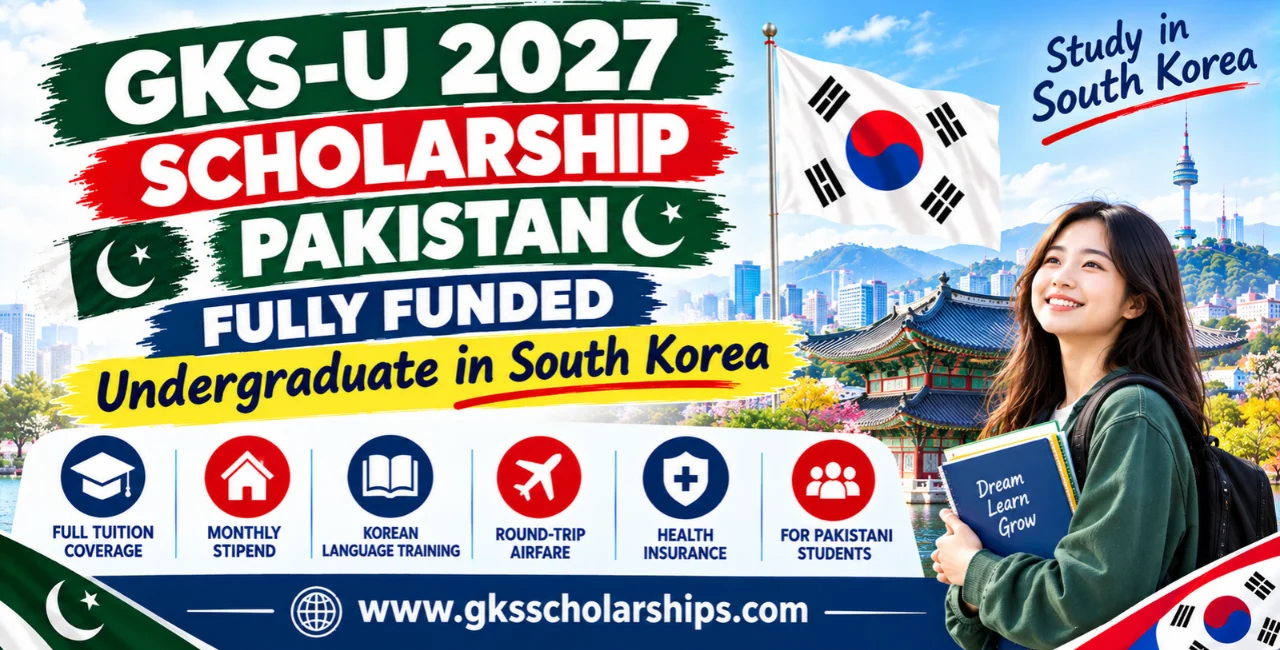
Most students know the Global Korea Scholarship. Fewer know how small the Pakistan quota can be. For the 2027 GKS undergraduate round, the Korean Embassy in Islamabad lists just 2 scholarships in total. And the deadline is not far away.
If you are a Pakistani student dreaming of a fully funded bachelor’s degree in Korea, this guide explains what the round involves, why the paperwork matters so much, and how to think about your chances.
The Deadline Is Very Close
Applications close on 30 September 2026, at 6:00 PM Korea Standard Time. In Pakistan time, that is 2:00 PM on 30 September 2026. The window opened on 15 September.
Do the maths on your own clock. Depending on when you read this, you may have only a day or two left. That matters a lot because of the document rule explained below.
What This Scholarship Is
The Global Korea Scholarship (GKS) is run by the National Institute for International Education (NIIED), an organisation under Korea’s Ministry of Education. Its purpose is to bring talented international students to Korea and strengthen education ties between countries.
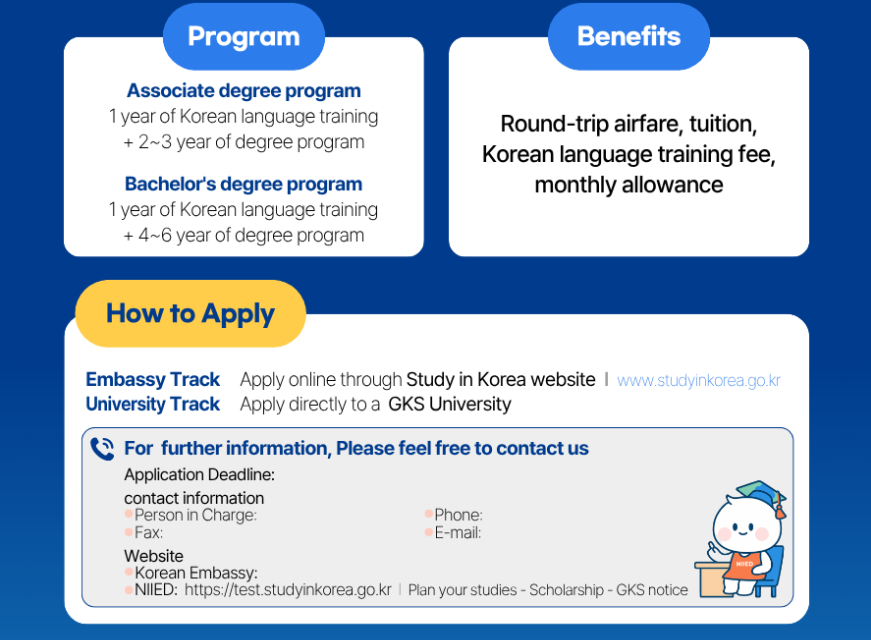
The GKS undergraduate programme follows a clear structure:
- 1 year of Korean language training
- Then 4 to 6 years of degree study, depending on your major
So you study Korean first, then move into your bachelor’s programme. It is a long commitment, and it suits students who are ready to live and study in Korea for five years or more.
The Number That Sets Expectations
The Embassy notice lists a total of 2 scholarships, with the General Program at 2 and R-GKS at 1. Either way, the message is the same: this is a very small quota.
This is not meant to discourage you. It is meant to help you plan. With so few places, a clean, complete, correctly prepared application matters more than in a larger programme. Small mistakes can cost you the whole round.
How Selection Works
The Embassy Track has several rounds, and each one removes applicants:
- First round: The Embassy screens documents and recommends candidates.
- Second round: NIIED screens the recommended applicants.
- Third round: Universities screen the remaining candidates. Final winners are chosen after this stage.
Some applicants who pass the first document screening will also be called for an interview. The Embassy says it will notify them individually. After document screening ends, it will post a separate notice about the results and the university screening process.
Choosing Universities: Where Many Applicants Go Wrong
This part is easy to overlook, but it can decide your result.
- General Program applicants can choose up to three universities from Type A and Type B. At least one must be a Type B university.
- R-GKS applicants can choose Type B universities only.
- You cannot apply to more than one department at the same university.
The Embassy also gives a clear warning. If too many applicants choose the same popular universities, candidates can fail the third-round university screening at all of their chosen schools. In plain words, picking only famous, top-ranked universities can backfire.
A smarter approach is to include options that fit your grades and your subject, not just the best-known names. Also choose your major with care. The notice says changing your field of study after final selection is strictly restricted.
The Apostille Rule: The Biggest Risk
This is the most important detail in the whole notice.
Pakistani applicants using the Embassy Track must submit documents with an Apostille at the first-round screening stage. The application guidelines list which documents need it. The Embassy warns that documents that do not meet the authentication standard may hurt your application.
An Apostille is an official certificate that confirms a document is genuine, so another country can accept it. Getting one usually means extra steps and processing time. It is not something you can finish in an hour on the last day.
What to do:
- Open the English application guidelines and check which of your documents need an Apostille.
- Start the authentication process immediately if you have not already.
- If you cannot finish it before the deadline, be honest with yourself about your chances this cycle. In that case, use the time to prepare properly for the next round rather than submitting a weak application.
How to Apply
The process is fully online:
- Go to the Study in Korea website (studyinkorea.go.kr).
- Create an account.
- Fill in the required application details.
- Upload all required documents.
You can find the notice on the site under: Plan your studies → Scholarships → GKS Notice → Notice No. 89. The Embassy also shares the English and Korean application guidelines, the application forms, and university information files on its website.
Read the full guidelines before you begin. The Embassy says all applicants should do this, and after reading the notice, it is clear why.
Key Dates at a Glance
- Application opens: 15 September 2026
- Application closes: 30 September 2026, 6:00 PM KST (2:00 PM Pakistan time)
- After that: Document screening, possible interviews, then university screening
Should You Apply?
Think about it this way. This scholarship is a great fit if you:
- Are ready for a long programme, including a Korean language year
- Can complete your Apostille-certified documents on time
- Have a clear idea of your major
- Are willing to choose your universities strategically
If the paperwork will not be ready in time, do not panic. GKS runs every year. Use this cycle to learn the process, collect and authenticate your documents early, and build a stronger application for next time.
The Bottom Line
The 2027 Global Korea Scholarship for undergraduates offers a rare chance at a fully funded degree in Korea, but the Pakistan quota is tiny and the rules are strict. The deadline is 30 September 2026, the Apostille requirement is the main hurdle, and your university choices can make or break the third round.
Check the official guidelines today, confirm your documents, and only submit if your application is complete and correctly authenticated.
