

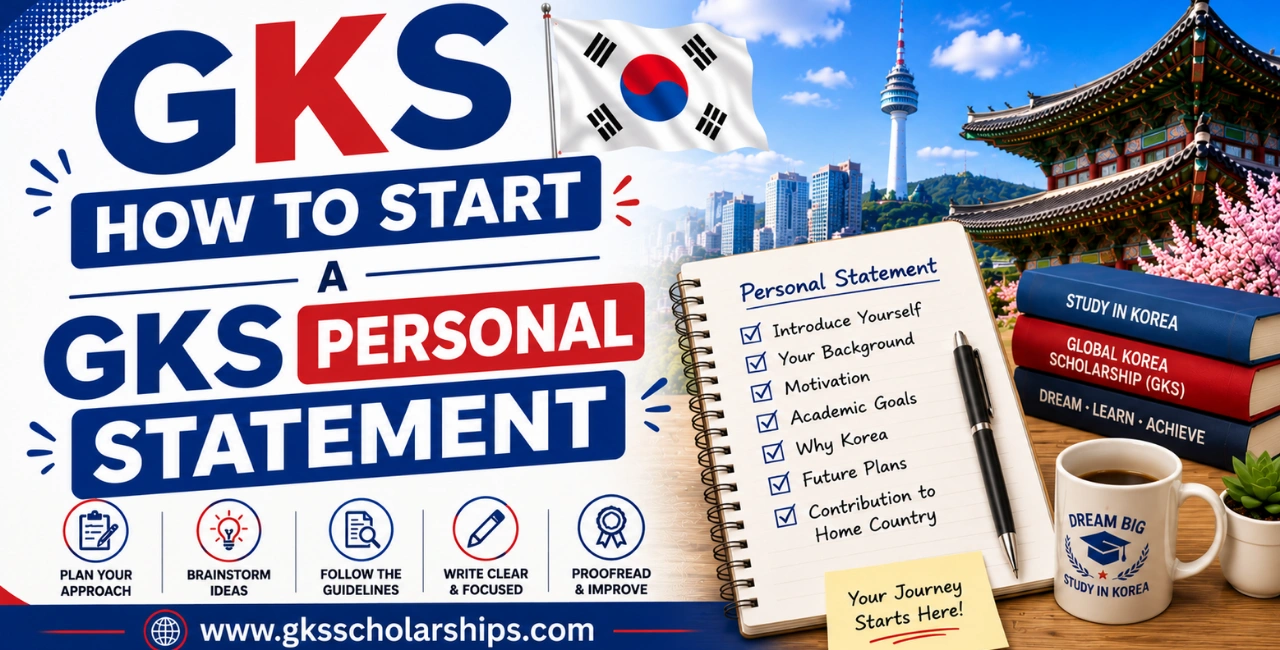
How to Start a GKS Personal Statement?
Quick answer: Open with one specific, real moment rather than a general claim about yourself. A concrete opening tends to read as more distinctive than a broad statement like “I have always loved learning,” though no single approach guarantees a particular outcome.
This page focuses narrowly on the opening — the first few sentences of your Personal Statement. For the complete document, including all five required elements, structure, and word limits, see the full GKS Personal Statement guide.
What Makes an Opening Stronger
An opening built around a specific moment gives the reader something concrete to picture, rather than a claim to take on faith.
Compare a general statement (“I have always been passionate about engineering“) with a specific one (“The bridge near my hometown flooded twice during my final year of school“). The second gives a reader an actual scene; the first could belong to almost any applicant.
This isn’t a guaranteed formula — a well-written general statement can still work, and a specific one written carelessly can still fall flat. But specificity generally gives your writing more to work with.
What to Avoid in Your Opening
“Since I was a child, I have always…” This is one of the most common openings in personal statements generally, GKS included, and it announces a trait instead of showing one.
A dictionary-style definition. Opening with “Education is the key that unlocks…” says nothing specific about you.
A general statement about Korea. “Korea is a country with rich culture and advanced technology” could open thousands of unrelated statements. Save Korea-specific reasoning for later, tied to something personal.
An apology or hedge. Starting with “I am not the most experienced applicant, but…” undercuts your statement before the reader has learned anything about you.
Practical Ways to Open
Drop into a specific moment. Start mid-scene, connected to your field or motivation, instead of summarizing your background first.
Open with a question someone asked you. A real question from a teacher or mentor can work well if your answer to it shaped your direction.
Start with a contrast or turning point. A before-and-after moment gives your first paragraph natural momentum.
Open with a small, telling detail. A specific object, place, or habit can say more than a broad claim about your character.
These are illustrations of an approach, not templates to copy. The moment that will actually work is one from your own experience — a borrowed or adapted example is usually recognizable as such.
Finding Your Own Opening Moment
Before writing a first sentence, work through a few questions:
- When did your interest in this field become real to you, rather than assumed?
- Has anyone asked you a question about your goals that you struggled to answer well at the time?
- Is there an object, place, or small detail connected to your academic path you could describe in two sentences?
- Was there a moment your plans clearly changed direction?
You’re looking for something specific enough that it couldn’t belong to someone else’s statement, even if the general theme is common.
From Opening Moment to Academic Motivation
A strong opening doesn’t stay on the moment itself — it moves somewhere. A useful way to think about that movement:
Specific moment → what you noticed or learned → academic interest → motivation for the field
Here’s a short, illustrative example of that progression (not a sample to copy — an illustration of the shape):
Moment: “During a school outreach project, I helped translate health pamphlets for a clinic that had run out of Korean-English materials.”
What was noticed: “I realized how much of the delay in patient care came down to language access, not medical resources.”
Academic interest: “That gap is what pulled me toward public health, and specifically toward how language and healthcare systems intersect.”
Motivation for the field: “It’s also why I want to study in a setting where I’ll need to navigate that gap myself, rather than only study it from a distance.”
Each step earns the next one. The moment isn’t decoration before the “real” motivation paragraph — it’s the evidence the motivation is built on.
Weak vs. Stronger Opening
Weak:
“Since I was young, I have always had a strong passion for engineering and problem-solving.”
Stronger:
“The bridge near my hometown flooded twice during my final year of school — the second time, I finally understood why the drainage design had failed the first time.”
The stronger version doesn’t claim a lifelong passion. It shows one moment, which the next few sentences can build outward from.
Common Mistakes
Writing a placeholder opening and never revisiting it. Many applicants draft a generic first line, finish the rest of the statement, and forget to come back. Sometimes a later paragraph makes a better opening than the one drafted first.
Trying to summarize an entire life in one sentence. One moment is enough. The rest of the statement has room to build from there.
Opening with something you couldn’t comfortably describe out loud. If your application includes an interview, it’s worth being able to speak to your opening moment naturally — see the GKS Interview Guide for more on that consistency.
Adapting an opening from a sample statement found online. Genuine, personal moments are difficult to replicate convincingly from someone else’s example.
A Note on the Form
Your opening isn’t a separate section — it’s simply the first sentence of the motivation portion of the official Form 2 template.
For the form’s layout, structure, and length limits, see the GKS Personal Statement Format guide.
Frequently Asked Questions
Does my opening need to mention Korea or GKS directly?
Not necessarily in the first sentence. It’s reasonable to open with a personal moment and connect it to Korea or your motivation for GKS a few sentences later.
How long should the opening be?
Typically a sentence or two. Its purpose is to draw the reader in — the following paragraphs can explain the moment further.
What if I don’t have a dramatic story to open with?
Most workable openings aren’t dramatic — they’re specific. An ordinary moment described with real detail tends to work better than an invented dramatic one.
Should I use one of the example openings from this page?
No — these are illustrations of an approach, not text to reuse. Reviewers are trying to learn about you specifically, and your own genuine experience is what makes an opening credible.
